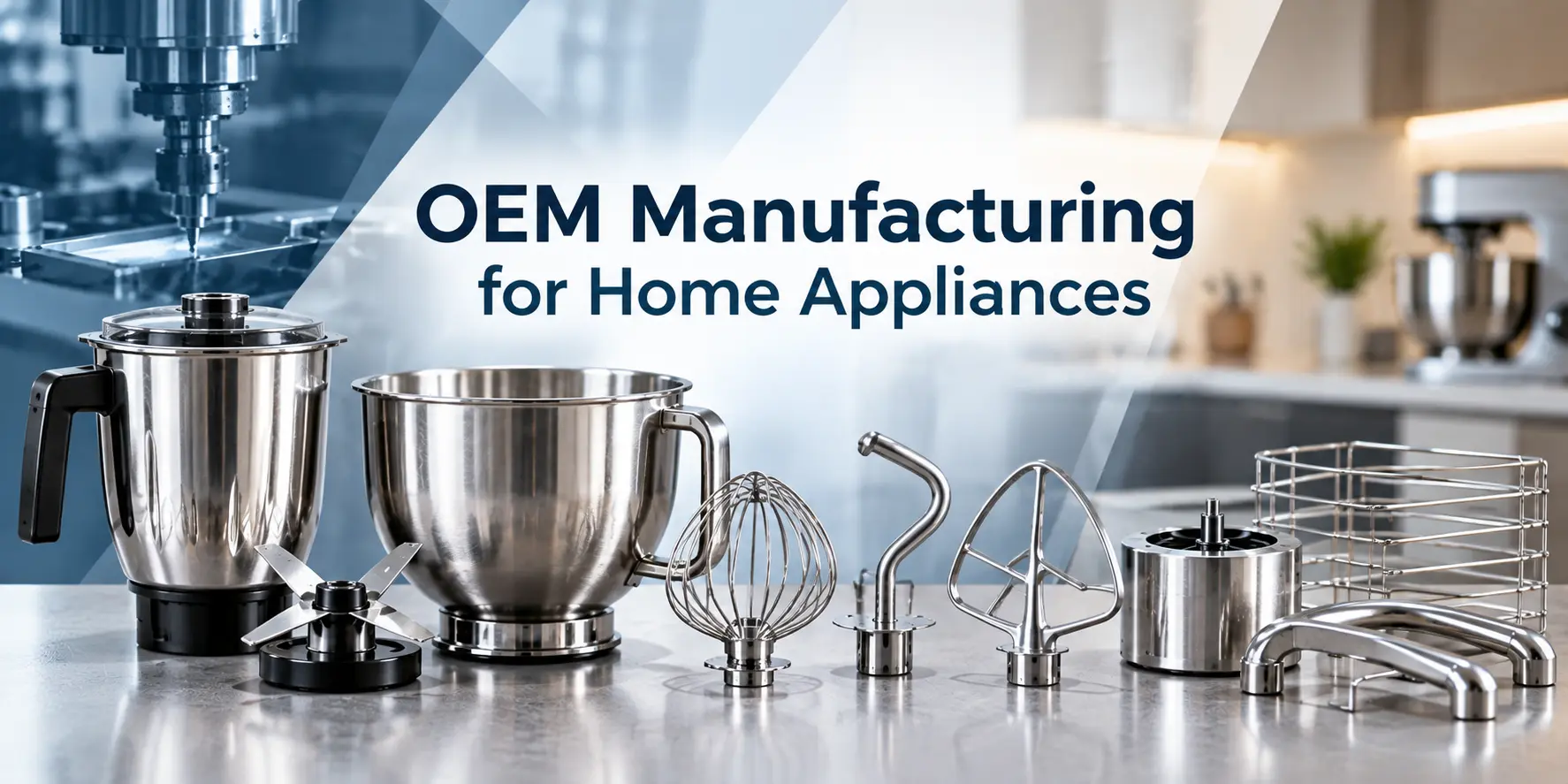
Consumer demands for kitchen appliances are constantly changing, and appliance brands are increasingly being pressured to provide them with products that perform well, are durable and have premium aesthetics. Although motors and electronics typically get the most headlines, the quality of stainless steel components such as stand mixer bowls, jars, blades, beaters and dough hooks is also a key factor in how well the appliance performs and lasts.
For a home appliance manufacturer, making the right component supplier decision is a strategic business decision. These are all directly linked to production efficiency, product reliability and brand reputation, especially in precision manufacturing, food-grade materials and customization capabilities, assuring consistent quality.
Top appliance manufacturers associate with Jindal Lifestyle for our precision-engineered stainless steel parts, and components are built to meet the rigorous quality standards and enable high-volume OEM production. Our skills and experience enable brands to take reliable, high-performing kitchen appliances to market, from the prototype stage to large-scale manufacture.
In this guide, we will look at the key parts of the stand mixer, materials used, the production process, sourcing hurdles and the things brands should take into account when deciding on an OEM manufacturing partner.
Why Stand Mixer Components Are Critical to Product Quality
Every stand mixer is only as reliable as the components that come into direct contact with ingredients. Bowls, jars, blades, and attachments experience continuous mechanical stress, frequent washing, exposure to moisture, and contact with acidic or oily food products.
Poor-quality components can lead to:
- Corrosion and discoloration
- Inconsistent mixing performance
- Excessive vibration
- Premature wear
- Customer complaints and warranty claims
- Reduced product lifespan
Conversely, precision-manufactured stainless steel components improve:
- Mixing efficiency
- Structural strength
- Food safety
- Corrosion resistance
- User experience
- Brand perception
For appliance brands, investing in high-quality OEM components reduces after-sales issues while enhancing product value in competitive domestic and international markets.
The Essential Components That Define Stand Mixer Performance
Each component within a stand mixer serves a specific function and requires precise engineering to ensure smooth operation.
1. Stand Mixer Bowls
The mixing bowl is the heart of every stand mixer. It must withstand continuous mixing forces while maintaining its shape, finish, and food safety characteristics.
At Jindal Lifestyle, OEM stand mixer bowls are manufactured using precision deep drawing techniques that create seamless, durable structures with excellent dimensional consistency.
Key features include:
- Food-grade stainless steel construction
- Mirror or satin finish options
- High corrosion resistance
- Reinforced rims for durability
- Ergonomic handle designs
- Multiple capacity options
- Custom locking and mounting configurations
These bowls are engineered for long service life while complementing the premium aesthetics expected by modern consumers.
2. Mixer Jars
Many stand mixers now incorporate multifunctional jars for blending, grinding, whisking, and food preparation.
A high-quality mixer jar must deliver:
- Leak-proof performance
- Excellent structural rigidity
- Smooth internal surfaces
- Accurate balancing
- Easy cleaning
Jindal Lifestyle manufactures stainless steel mixer jars with tight dimensional tolerances, ensuring compatibility with multiple appliance platforms while maintaining excellent performance under high-speed operation.
OEM customization options include:
- Capacity variations
- Lid compatibility
- Surface finishes
- Branding and laser marking
- Handle configurations
3. Mixer Blades
Blades are among the most critical components influencing appliance performance.
Precision blade geometry determines:
- Ingredient consistency
- Mixing speed
- Cutting efficiency
- Energy consumption
- Noise levels
Jindal Lifestyle manufactures stainless steel mixer blades using advanced laser cutting, CNC machining, and precision grinding processes to achieve:
- Uniform cutting edges
- Excellent balance
- Superior wear resistance
- Long-lasting sharpness
- High-speed operational stability
Each blade undergoes rigorous inspection to ensure reliable performance across thousands of operating cycles.
4. Beaters & Dough Hooks
Different recipes require specialized mixing attachments, making beaters and dough hooks essential components in stand mixer systems.
Common OEM attachments include:
- Flat beaters for cake batters
- Balloon whisks for whipping
- Spiral dough hooks for bread making
- Specialty mixing accessories
Manufactured from premium stainless steel, these attachments are engineered for strength, dimensional accuracy, and long-term durability. Precision fabrication minimizes vibration while ensuring consistent mixing performance.
Why Stainless Steel Is the Preferred Material for Stand Mixer Components
Material selection is one of the most important decisions in OEM appliance manufacturing. Stainless steel remains the preferred choice because it combines hygiene, durability, corrosion resistance, and visual appeal.
Food Safety
Food-grade stainless steel is non-reactive, ensuring ingredients retain their natural taste without contamination.
Corrosion Resistance
Unlike conventional metals, stainless steel withstands moisture, acidic ingredients, detergents, and repeated washing.
Strength and Durability
Its excellent mechanical properties allow bowls, jars, and blades to withstand continuous use without deformation.
Easy Maintenance
Smooth polished surfaces resist staining and simplify cleaning, supporting better kitchen hygiene.
Premium Appearance
Mirror-polished and brushed finishes enhance the overall look of premium kitchen appliances.
For most food-contact applications, SS304 stainless steel is the preferred material due to its excellent balance of corrosion resistance, strength, and food safety compliance.
Key Manufacturing Processes Behind High-Quality Stand Mixer Components
Producing reliable OEM stand mixer components requires advanced manufacturing technologies and strict process control.
At Jindal Lifestyle, every stage of production is carefully monitored to ensure consistency and precision.
1. Material Selection
Production begins with high-quality stainless steel sourced to meet strict mechanical and food-grade requirements.
2. Precision Deep Drawing
Advanced deep drawing technology creates seamless bowls and jars with excellent structural integrity and uniform wall thickness.
3. Laser Cutting
Computer-controlled laser cutting ensures highly accurate blade profiles while minimizing material waste.
4. CNC Machining
Critical dimensions and mounting interfaces are machined to precise tolerances for seamless assembly.
5. Welding & Assembly
Automated welding techniques improve structural strength while maintaining consistent quality across production batches.
6. Surface Finishing
Mirror polishing, satin finishing, deburring, and passivation enhance corrosion resistance, hygiene, and product aesthetics.
7. Comprehensive Quality Inspection
Every component undergoes rigorous quality checks, including:
- Dimensional inspection
- Surface finish evaluation
- Weld integrity testing
- Material verification
- Functional performance testing
- Visual inspection
These quality control measures help ensure every component meets OEM specifications before shipment.
Common Challenges in Sourcing OEM Stand Mixer Components
Selecting the wrong manufacturing partner can create significant operational and quality challenges.
Some of the most common issues include:
1. Inconsistent Stainless Steel Quality
Using lower-grade materials may lead to corrosion, discoloration, and reduced product lifespan.
2. Dimensional Inaccuracy
Even minor deviations can affect assembly, create vibration, and reduce overall appliance performance.
3. Limited Engineering Support
Suppliers lacking design expertise often struggle to support new product development and customization.
4. Quality Control Gaps
Insufficient inspection increases the risk of defective components entering production.
5. Production Delays
Limited manufacturing capacity or inefficient planning can disrupt supply chains and delay product launches.
Working with an experienced OEM manufacturer like Jindal Lifestyle helps mitigate these risks through standardized manufacturing processes, advanced production capabilities, and robust quality systems.
How to Evaluate an OEM Manufacturing Partner: A Checklist for Appliance Brands
Choosing the right OEM partner requires evaluating much more than pricing.
Look for manufacturers that offer:
- Proven expertise in stainless steel appliance components
- Food-grade material capabilities
- Advanced deep drawing and metal forming
- In-house tooling and die development
- CNC machining and laser cutting
- Prototype development support
- Strong engineering and design assistance
- ISO-certified quality management systems
- Comprehensive quality inspection
- High-volume production capabilities
- Reliable delivery performance
- Export experience and global supply capabilities
A capable manufacturing partner becomes an extension of your product development team, helping improve quality while reducing production risks.
OEM Customization Options for Stand Mixer Components
Every appliance brand has unique design, performance, and branding requirements. Customization enables manufacturers to differentiate products while maintaining production efficiency.
Jindal Lifestyle offers a wide range of OEM customization options, including:
- Custom bowl capacities and dimensions
- Unique jar designs
- Branded embossing and laser engraving
- Customized blade geometries
- Mirror, satin, or brushed finishes
- Specialized handles and locking systems
- Assembly-ready component kits
- Private labeling
- Custom packaging solutions
With in-house tooling and engineering support, we help appliance brands transform concepts into production-ready components with shorter development cycles.
Partnering with Jindal Lifestyle for High-Quality Stand Mixer Components
Jindal Lifestyle is a trusted OEM manufacturing partner for leading kitchen appliance brands, delivering precision-engineered stainless steel components that combine quality, durability, and manufacturing consistency.
Our integrated manufacturing capabilities include:
- Food-grade stainless steel processing
- Precision deep drawing and metal forming
- In-house tooling and die development
- CNC machining
- Laser cutting
- Robotic welding
- Mirror and satin surface finishing
- Assembly-ready component manufacturing
- Rigorous quality inspection
- High-volume OEM production
Whether you require stand mixer bowls, jars, blades, beaters, dough hooks, or complete assembly-ready component sets, Jindal Lifestyle offers end-to-end manufacturing solutions tailored to your product specifications.
By combining engineering expertise with advanced manufacturing infrastructure and stringent quality control, we help appliance brands accelerate product development, maintain consistent quality, and build long-term customer trust.
FAQs
1. What stainless steel grade is used for OEM stand mixer bowls and jars?
For OEM stand mixer bowls and jar SS304 grade stainless steel is used as it has excellent corrosion resistance, durability and meets the strict requirements of food contac. There are many different materials which can be used depending on the application performance and cost.
2. Can bowl and jar capacity be customized for different mixer models?
Yes. To suit the design needs of various stand mixer models, Jindal Lifestyle provides customized capacities of bowl and jar, thickness of their walls, dimensions, finishes and mounting configurations.
3. Does Jindal Lifestyle support in-house tooling and prototyping for new mixer designs?
Absolutely. Our in-house tooling, die development, and prototype manufacturing capabilities enable appliance brands to validate designs, optimize functionality, and reduce product development timelines before mass production.
4. Can appliance brands source bowls, jars, and blades as a complete assembly-ready set?
Yes. Jindal Lifestyle offers full OEM parts solutions, from bowls to jars, blades to beaters, dough hooks to accessories, it caters to all your needs and makes procurement easier and saves you from worrying about parts compatibility.
5. What quality standards and certifications should an OEM manufacturer meet?
The OEM manufacturing partner should have a solid quality management system, like ISO 9001, use certified food-grade stainless steel, keep material traceability and also have stringent inspection practices to provide consistency and compliance with regulation.
6. What are the common challenges in sourcing OEM stand mixer components?
Such sourcing issues as inconsistent material quality, dimensional inaccuracies, limited customization capabilities, inadequate quality control, and slow supply chain are common. An experienced manufacturer like Jindal Lifestyle can help overcome these challenges with state-of-the-art manufacturing technologies, engineering know-how and reliable manufacturing processes.